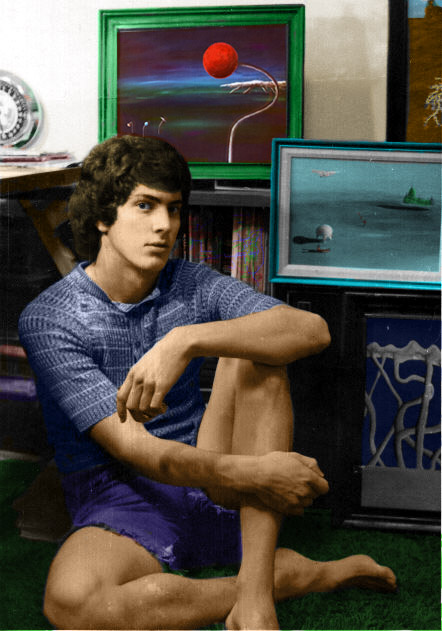
 Photo by Doug Pinkston
Kaz Maslanka has always been interested in the mysterious. After earning a ham radio license at the age of 14, he talked of how he sensed the presence of radio waves distant cities as he 'watched' 60 foot waves come out of his antenna, traveling at the speed of light, penetrating the sky to the ionosphere 250 miles above the planet, and bouncing across the terrain and sky. It's the magic of electromagnetic waves, invisible, powerful, vessels that travel 186,000 miles per second. “Pure magic” he exclaims, “There are not many things as mysterious as light.” It is this passion for mystery that fueled Kaz in his early days of formal art education. His influences go back to his high school days in West Tulsa, Oklahoma. While looking in an art history book he saw a section on Surrealism. It was the images in that book which kindled his desire to seriously make art and which peaked his own sense of wonder at the magical sublime elements of the mind. It was surrealist imagery that inspired him to create his language for painting the sounds he saw while listening to music.
Webster defines synesthesia as a phenomenon in which the stimulation of one sense produces a mental impression associated with a different sense, as color hearing, in which certain sounds are connected with certain colors.
Since Kaz was not aware there was already a term for this phenomenon, he coined the term 'metaphonics' as there seemed to be something underneath the sounds he heard. Examples of this type of painting:
"SFZ or sforzando" (1973, acrylic on canvasboard)
was one of Kaz's first synesthetic paintings. The image came to
him from the first movement in "The Question of Balance"
a song by the Moody Blues.
"Interstellar
Overdrive" (1974, acrylic
on canvasboard),"Syncopated
Pandemonium" (1974, acrylic
on canvasboard) and"Drums
from Syncopated Pandemonium"(1977, wood assemblage) were all inspired
from certain sections of Pink Floyd songs: "Interstellar
Overdrive" and "Saucerful of secrets" respectively.
"Thunder" (1974, oil on canvasboard) evolved from the sound
of thunder.
In 1978 Kaz was working as a night watchman alone in a remote
aircraft plant when he heard on the balcony above his head, footsteps
on a creaky wood floor. Even though the experience frightened
him, he saw an image of the sound. "Hard
soled footstep on a creaky wood floor under paranoid conditions"
(1978, raku fired and painted ceramic)
It was durring this period that a university psychology professor introduced Kaz to the term synesthesia and to the realization that many other people experience seeing sounds. This stirred Kaz's curiosity and he set about to try to rationalize his experiences. Although he feels pure synesthesia is experiencing images automatically, there exists an empirical synesthesia in most of us. When most people are asked, "What is the color of a scream?" they often reply: 'orange', 'red', or 'yellow' and sometimes, 'black'. If asked about the shape, many say; tubular with jagged exterior edges'. Another example Kaz cites would be to imagine standing on a concrete floor and having a person drop a croquet ball on the foor behind you. It would convey by its rhythm, its spherical shape. For if it were a cuboidal object, the rhythm would be much more syncopated. One could also tell if it were hollow, solid, plastic, metalic or wood. There is a visual picture of what's occuring even though the ball can't be seen. Because of past interactions of multisensory experiences with nature, visual information is passed through sounds. Using this idea as springboard, Kaz termed the concept 'empirical synesthesia' and worked on creating a visual language from aural experiences.
The following sculptures are examples of empirical synesthesia:"Hard-soled footstep on a creaky wood foor under normal conditions" (1978, glazed and painted ceramic and steel)"Tennis shoe on concrete" (1978, painted ceramic) image 1"Tennis shoe on concrete"(1978, painted ceramic) image 2"Hard-soled footstep ascending a hollow wood staircase" (1978, glazed and painted ceramic)