Mathematical poetry is an artistic expression created by performing mathematical operations on words or images as if they were numbers. One may find this baffling because it seems we are being confused about the states of quality versus quantity. However, it is through the fusion of this dichotomy that mathematical metaphor is spawned. Within the vast majority of mathematical equations, denotation is the intended goal. In general, it is safe to say that that our intention for the use of mathematical equations in the sciences is denotative. However, within the scope of mathematical poetry our interest is to use math as a language for connotation. This essay addresses the differences in metaphor and simile with respect to mathematical equations and their use in three different pieces of art work that utilize the concept of mathematical poetry.
Metaphor and mathematics:
To use math for connotation we must first look at the mathematical structure of metaphor. Let us look at the differences in simile and metaphor within the context of a sentence. “Bob runs like a deer” is a good example of simile. The keyword in the sentence is ‘like’. We are comparing Bob to a deer and it is the word ‘like’ that makes this sentence function as a simile. Let us change the sentence into a metaphor by stating, “Bob is a deer”. Notice the word ‘like’ is missing we are not making a comparison we are saying that Bob = deer. Now we know that this seems to be nonsense on the surface because we know that Bob is a human being. However, the purpose of a metaphor is to point to a truth that is not on the surface. Metaphor is about synergetic fusion of ideas and not about comparison. Although one has to compare the meaning of the terms in order to fuse the ideas in ones mind. The intention of a metaphor is to point beyond rational thinking to some level of consciousness unobtainable with simile. A Metaphorical sentence must never have the word ‘like’ in it even if it is the author’s intention to call it a metaphor. The author is in error in doing so for a metaphor is not a comparison it is a fusion or integration of two or more concepts into single concept, which points beyond the initial concepts, used to construct the metaphor.
Unfortunately, there can be some confusion with the intent of simile. Our language allows us to have the intention of simile and yet express the same words used in a metaphor. i.e. A person could have the intent of making a simile and saying, “Bob is a deer”, and this statement is considered acceptable as such. However, it is confusing when striving for simile one should always use the word ‘like’. Physics equations function as simile by making denotative comparisons between physical concepts or processes yet we use the same terminology as metaphor by saying one thing is equal to another e.g. “distance = speed multiplied by time”.Let me reiterate that this is the same terminology that we use for metaphor“Bob = deer”. Therefore, we see that intent of metaphor is an important key element in the language of poetry/art. In the arts, we tend to avoid using a metaphoric structure when our intent is simile. In science we avoid thinking in terms of metaphor even if we are using a metaphorical structure as in “A = B”
It is interesting to note that mathematical equations lend themselves perfectly to the use of connotation for their structure is naturally metaphoric i.e. ‘A = B’ Therefore if our intention is metaphor and we know colloquially that ‘A’ never equals ‘B’ but we wish to point to something beyond both ‘A’ and ‘B’ then we may express ‘A = B’. One of the elements in how we distinguish good art from bad art is by judging the choices the artist makes when constructing the metaphor. Creating good metaphors is extremely difficult and achievable by only a few. The intent is to fuse dissimilar ideas to point at a truth that is rationally not expressible. If the reader/receiver of the art resonates with the truths put forth, then they tend to judge the art as good. It is the intent of many artists to discover these truths or archetypes and express them in ways understood by all.
Golden fear:
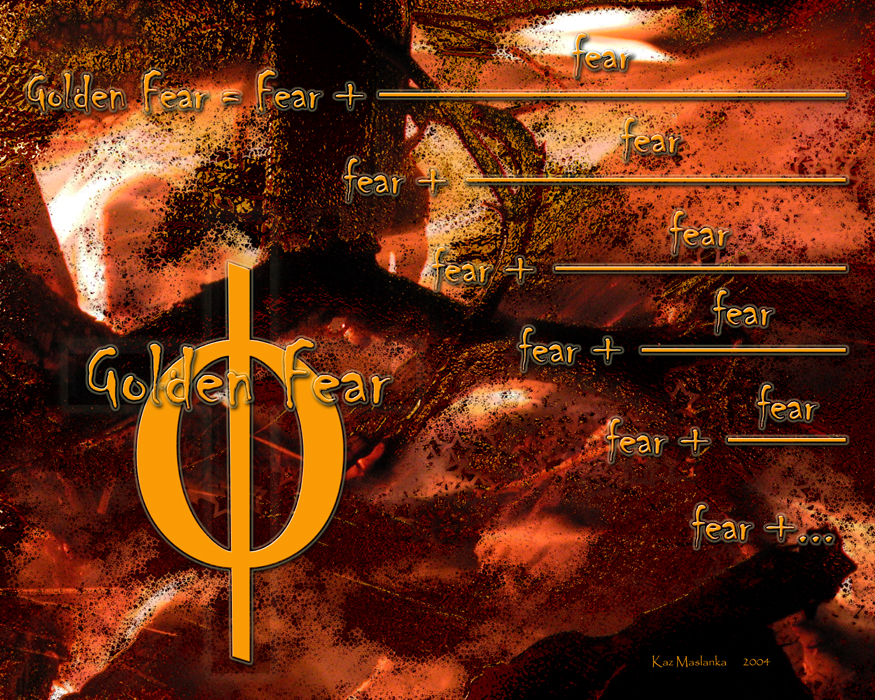
“Golden fear” (see figure 1) is a perfect example of a mathematical metaphor expressed in the continued fraction that describes the golden ratio. In this expression, we see that the word fear has been substituted for the number ‘1’. In other words, fear and the number ‘1’ are the same thing in the context of this artistic expression. The two ideas of fear and the number ‘1’ are fused to point at an idea of a “Golden fear”. Alternatively, this could be an expression that points to some natural power that is both beautiful and feared. The precise meaning is of course determined in the mind of the viewer, as is all metaphors.
For more information on the golden ratio follow the following link: http://mathworld.wolfram.com/GoldenRatio.html