The Polyaesthetic View of Aesthetics
Polyaesthetic Mapping
Kaz Maslanka
July 4, 2011
What this is:
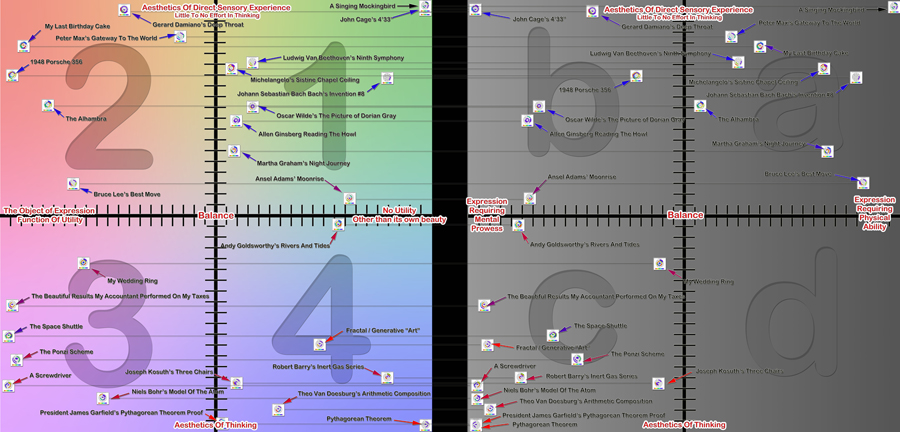
I believe that if you work yourself through this simple system that you will have a better understanding of the differences between the aesthetics of science and the aesthetics of art. In fact if you are only interested in art then I believe you will finally have an understanding of art to which you can make a solid clear definition that is easily defended. However, the first prejudice must be dropped. You must not confuse value judgment with category. Most people who discuss aesthetics make this mistake and I have even heard a famous art critic or two do this. One cannot look at an expression and deem it ‘not art’ just because it is bad art. Bad art is still art no matter how bad it is. Now there can be expressions that one would like to call art, however, when analyzed it finds itself with more neighbors of science than art. If it is barking then it probably is a dog even if you want to call it a cat. Then there is the case that one may want to call something fine art when it is clearly a utilitarian object with aesthetics employed to sell it. The polyaesthetic mapping is about category not about judgment of value. I am not interested in trying to define beauty with this system.
Let me make some definitions that you must realize that they work only within the polyaesthetic mapping system. And have no meaning outside of it - so before you throw rocks at it please go completely through the system.
Aesthetics describes merely an emotional reaction to an expression and it can be good or bad.
The aesthetics of ‘pure art’ is about pure direct experience no matter how good or bad that experience is. One does not have to think about ‘pure art’ they just react to it.
The aesthetics of ‘pure science’ is about the emotions felt while thinking. The beauty in science is mostly about the beauty of thinking.
The boring definition of polyaesthetic mapping is the following:
This is a system whereby one can map any aesthetic experience over twenty seven categories culminating with six of those categories displayed in a three dimensional space. It functions as a result of you asking yourself what is the importance of each aesthetic category as it applies to the aesthetic experience in question. In other words the aesthetic experience is categorized by what you think is important.
What this is not:
This is not an attempt to dictate how you should view a particular aesthetic experience. Although, there are examples in this system, these examples are subjective views by me yet, it is probable that you and I may find common ground in our experience. My only purpose is to show you a system where you can see how almost, if not all aesthetic experiences have aspects of both science and art. This system may raise more questions than answers, yet, I hope it helps you see the vista of aesthetics from a different perspective. Personally speaking, this system gives me insight into why twentieth century art brought about aesthetic confusion and made simple definitions of art so elusive. I think this system can shed light on why some scientists feel that there are aspects of what they do that they find to be art. In addition, I think that this system shows that there are many aesthetic facets to almost every aesthetic experience that we have. That categorizing anything as purely art or purely science is almost, if not futile.
Click On The Image Below To Go To The Introduction

Click On The Image Below To Go To The Major Window