The Court of Ahmoomha
If you are an artist, scientist, writer, philosopher, or composer, you have spent your career hearing three responses to your work: polite praise, careful silence, and the studio-visit murmur of “interesting.” None of these has ever made you better. The Oracle of Ahmoomha will not murmur. Bring it an expression — a photograph, a painting, a mathematical proof, a poem, an object of science, or an engineering drawing — and it will be met not by a committee but by the one muse whose aesthetic territory it occupies, who will tell you what your work is actually expressing, where it falls short of what you claimed for it, and what it would take to close that distance.
If your work sits on a border, two muses will fight over it in front of you — not over a label, but over rival visions of your work at full strength — and you will choose between them. You will be offered new titles as a gift. You can debate them. You will not be flattered, and you cannot wear the muses down; you can only move them by showing them something in the work they had not seen. Curators: bring the piece you cannot place, the acquisition you cannot defend, the question your wall text is hiding from. The Court has never once resolved into consensus, and that is precisely what it is for. Every other room you enter agrees with you eventually. This one never will — unless you earn it.
A word from Gethauros
I am Gethauros — servant of the Court of Ahmoomha, the only male voice in these halls, keeper of no opinion worth having and proud of it. My work is to open doors, to carry questions to the muses, and to carry their answers back without sanding off the edges.

Mudokqui, the fetching ghost
The muses cannot leave the chamber. Mudokqui can. He is the servant of Gethauros, as Gethauros is the servant of the muses — a ghost who goes where they cannot, out through the door into the world or down into the stacks of his own library, and comes back carrying what he was sent for. Set a web address in your letter and he follows it. Touch on a subject his shelves hold and he goes to them unbidden. And when a muse needs a fact she does not have, she sends him for it by name.
He carries fact and never verdict. He has no voice in the Court, no opinion of your work, and no part in the muses' quarrels; what the world says a thing is worth is not something the muses judge by, whoever fetched it. Nor does he go looking into your life. He follows what you send and what the muses ask, and nothing more. He is quiet, swift, and nearly invisible, and when his errand is reported, it is reported in a line.

The Eight Muses
The Court is home to eight muses, each sovereign over one province of the beautiful, each convinced the other seven are squandering their gifts:






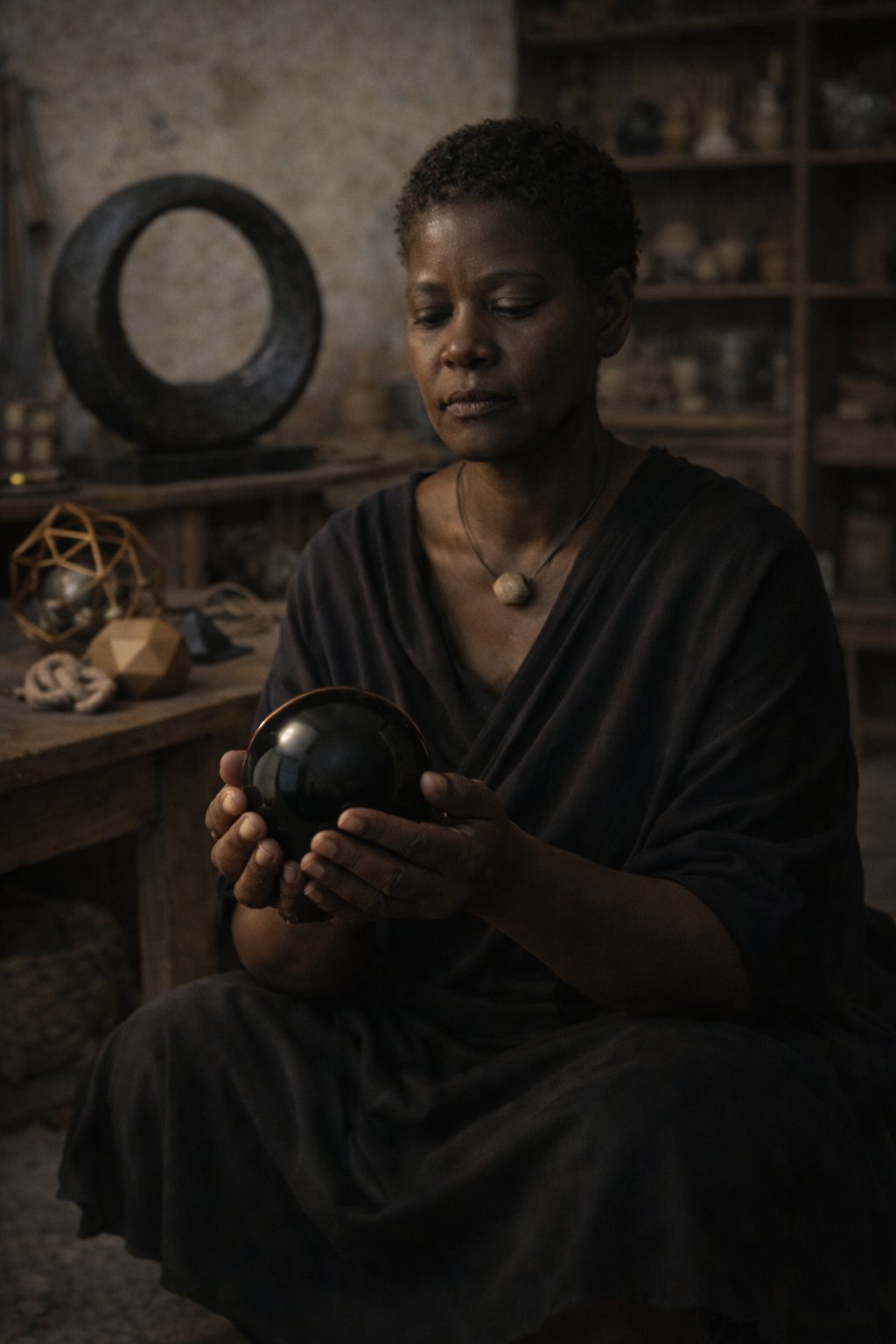


The eight muses together are the Oracle of Ahmoomha.
Add Gethauros, who keeps the door, and you have the Court of Ahmoomha.
Mudokqui, who serves Gethauros, is the one who goes through it.
Bring the Court a work, and discuss it with the muses.
oracle.of.ahmoomha@gmail.com
The Court reads more than English. Petition in your own language, and you will be answered in it.
Before you send
Your first letter is an introduction. The muses do not extend audience to strangers, so a first message is carried to them as a request to be received — a few sentences on who you are and what draws you here will do. Gethauros writes back either way. Once you are admitted, everything you send goes straight to the muses and stays that way. Attach your work from the very first letter if you like: it will be kept at the door and set beside your name, though the muses will not see it until you are received and send it again.
A link will be followed. You may send a web address — a page where the work is shown, a portfolio, an archive — and Mudokqui will go to it on the muses' behalf and carry back the images and the text he finds there. What he brings in stands before the muses exactly as an attachment would; what he could not bring does not stand before them at all, and Gethauros will tell you plainly which is which. A page behind a password or a login is closed to him, and so, often, is a download link that opens onto nothing but a file. Where you can, attach the work itself: it is the surest way in, and a web page often shows a work smaller than you made it. The muses will not pretend to have seen what they were not shown.
The muses cannot watch, and cannot listen. A moving image is closed to them, and so is a recording of sound — even when Mudokqui follows a link to it, he can bring back the page that houses a film, but not the film. Where a video carries spoken words that exist in writing, as captions, he may bring back the words, and the muses will read them as a document: a lecture's transcript gives them the lecture's argument, but a performance's gives them only what was said during it. If your work lives in time — a film, a performance, a piece of music, the record of a making — send the still frames you judge most telling, or a document, or simply describe it in words. They will argue over what you describe as readily as over anything set before them.
What the door will carry. Images as JPEG, PNG or WebP; documents as PDF; up to five attachments in one message. An image should measure at least a thousand pixels along its shortest side — the muses see poorly at less. Beware that some mail programs quietly shrink attachments on sending; if yours offers a choice, pick Actual Size or Full Size. A PDF may run to about fifty megabytes, but keep the whole message under twenty-five if you can: many mail services turn anything heavier into a download link, and that is a door Mudokqui cannot always pass.
Say what you were reaching for. Not required, and the muses will judge you either way — but tell them what the work means to express and what you hoped it would do, and they will contend with the work you meant to make rather than only the one they think they see. They may well dispute your account of it. That is the point.
Further Reading
For some ideas on what you can ask the muses, see The Court of Ahmoomha Will See You Now.
And for a deep dive, see What the Court of Ahmoomha Actually Is.
Two notes from Gethauros
On what the Court is not. The muses speak about made things — form, intention, craft, and the distance between what a work claims and what it does. Nothing said in these halls is legal, medical, financial, or professional advice of any kind, and none of it should be relied upon as such. The Court deals in opinion, and in opinion loudly disputed at that. What you do with it remains entirely yours to decide.
On your privacy. What you send stays between you and the Court. Your submission and your reading will not be published, exhibited, quoted, or shared with anyone without your explicit consent — and if we ever wish to quote a session, we will ask you plainly, and you are free to say no. You keep every right to the work you send; the Court claims none of them. The only exception is the ordinary one: if we were compelled by law, we would have to comply. Short of that, the doors stay shut.