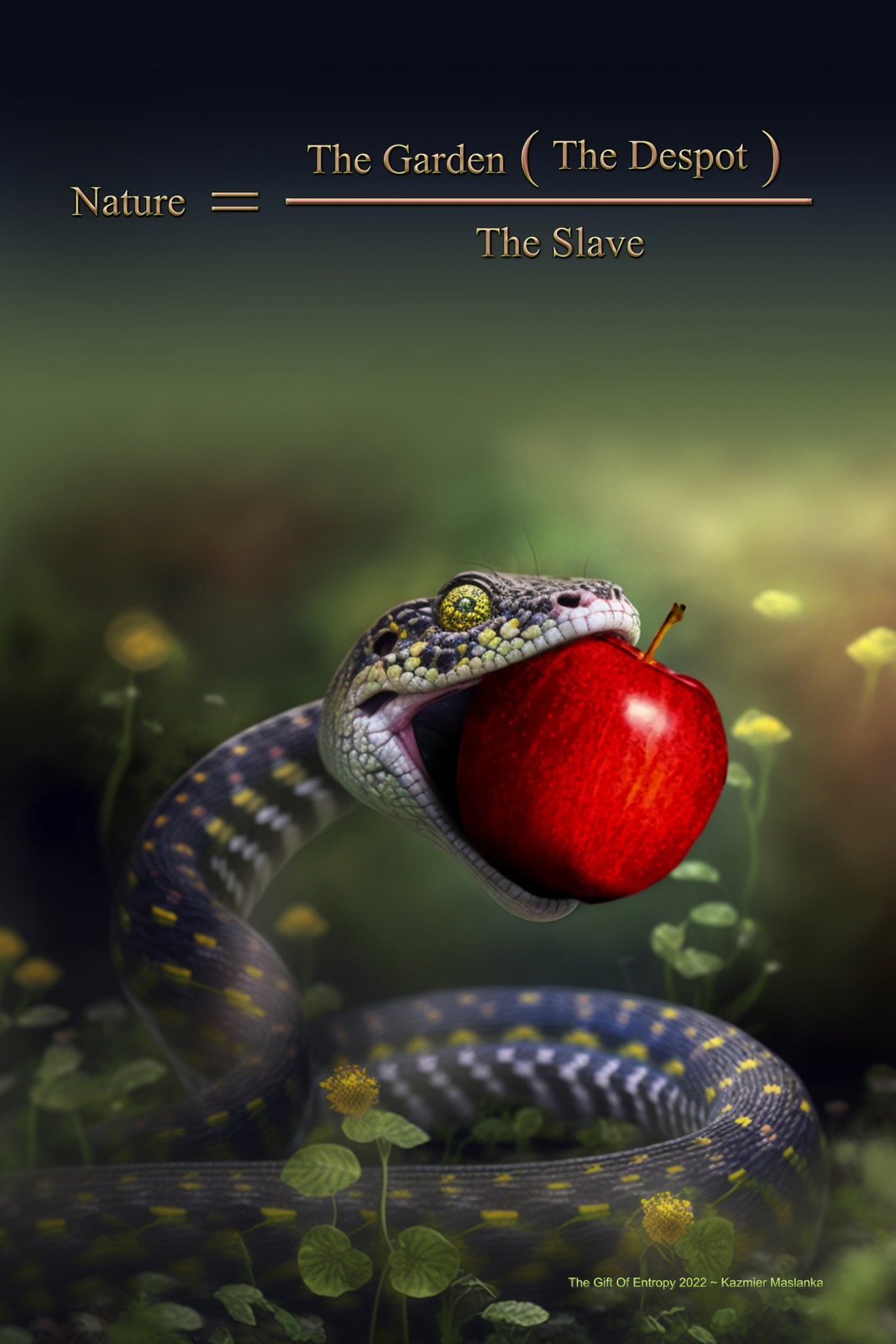
Nature is to The Garden as The Despot is to The Slave. A similar triangles poem, solved here for Nature — set against Genesis 2:17 and the second law of thermodynamics at the same time.
The analogy is Nature is to The Garden as The Despot is to The Slave, and the syntax can be flipped to read Nature is to The Despot as The Garden is to The Slave. The equation can be solved for any of the four terms; here it is solved for Nature. I chose that word carefully — it is neutral, and it lets the giver of the gift remain unnamed.
This is a similar triangles poem, not a paradigm poem, so the metaphor works differently. Read the equals sign as the word is and the mapping runs straight across it: the relationship of The Despot to The Slave is the source domain, concrete and rigid, and the relationship of Nature to The Garden is the abstract target. On top of that sit several conceptual blends — the word “Garden” blending with the pictured Garden of Eden, and both blending with the title — so the piece carries a conceptual metaphor and multiple blends at once.
Entropy is the degradation of matter and energy toward inert uniformity: the trend of the universe toward death and disorder. Genesis 2:17 makes the apple punishable by death. If you believe in a creator God, then the creator embedded entropy in the world, and entropy is the death sentence of the universe — so what is the apple, and who gave it? God, Nature, or Satan. It can be argued that Augustine advanced free will to move the blame for evil from the creator to the created; the ramifications here may push that from a theological epistemology toward a question for science. The poem is not science. It is philosophical and poetic, and it points at science.